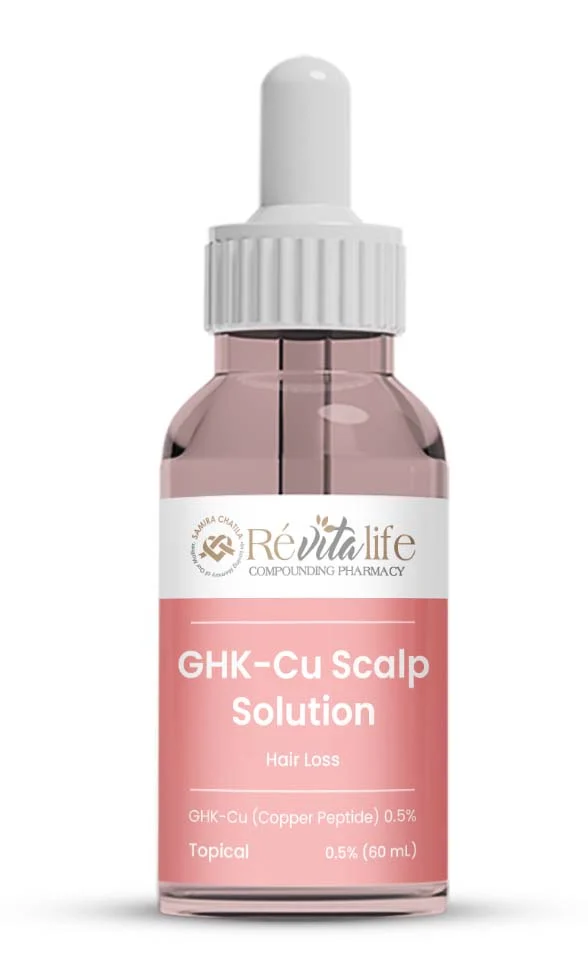
GHK-Cu Scalp Solution is a pharmacy-compounded topical preparation that may support scalp health and hair appearance by delivering the tripeptide glycyl-L-histidyl-L-lysine complexed with copper at a nominal 0.5 % concentration in a 60 mL vehicle. The GHK peptide, first isolated from human plasma, has been reported to participate in tissue-protective and regenerative…
Prescription-led preparation
Availability and formulation are confirmed by the pharmacy after professional review.
Product overview
Explore the preparation, dosage, clinical information, precautions, storage guidance and references held in this product record.
GHK-Cu Scalp Solution is a pharmacy-compounded topical preparation that may support scalp health and hair appearance by delivering the tripeptide glycyl-L-histidyl-L-lysine complexed with copper at a nominal 0.5 % concentration in a 60 mL vehicle.
The GHK peptide, first isolated from human plasma, has been reported to participate in tissue-protective and regenerative processes, although definitive clinical efficacy in hair disorders remains under investigation. [1]
Because this formulation is individually prepared, composition and excipients can vary slightly according to prescriber specification. This product is available by prescription from a 503A compounding pharmacy.
Compounded GHK-Cu is not an FDA-approved drug product; instead, clinicians sometimes prescribe it when they judge that its potential benefits-such as promoting a healthier scalp environment-could outweigh theoretical risks in selected patients.
Historical cosmetic and preclinical data suggest that topical copper peptides may improve hair shaft diameter and reduce shedding, yet controlled, large-scale clinical trials are sparse. [1]
A frequently employed regimen involves applying approximately 1-2 mL of the 0.5 % solution to affected scalp regions once to twice daily, preferably on clean, dry skin in the evening.
The dropper may be used to distribute small aliquots across thinning areas, followed by gentle digital massage to facilitate even coverage.
Treatment courses often extend for at least three to six months before meaningful cosmetic changes might be appreciated, and continued application may be required to maintain any gains.
If a dose is missed, patients could apply it when remembered on the same day or resume the regular schedule at the next planned administration-double dosing is not recommended. [8]
Any deviations from prescriber instructions should be discussed with the supervising clinician.
Current laboratory evidence indicates that GHK-Cu may influence several biochemical pathways that collectively could foster a more favorable milieu for follicular activity.
First, the complex appears to act as a copper transporter, delivering ionic copper to cutaneous cells where it may activate copper-dependent enzymes involved in extracellular-matrix remodeling and angiogenesis. [2]
Second, in cultured dermal microvascular and fibroblast models, GHK-Cu exposure has been associated with increased vascular endothelial growth factor expression, a change that could enhance perifollicular microcirculation. [3]
Additional in-vitro studies suggest that GHK-Cu may down-regulate transforming growth factor-β1, a cytokine implicated in premature follicle regression, thereby potentially prolonging the anagen (growth) phase. [4]
Separate investigations on human dermal papilla cell cultures have shown that related copper peptides can stimulate cell proliferation and reduce apoptotic signaling, findings that could translate into stronger follicular support in vivo.
Finally, preliminary ex-vivo data propose that the peptide complex might trigger Wnt/β-catenin signaling cascades, pathways recognized for their role in hair follicle morphogenesis-although confirmation in human scalp tissue remains limited. [5]
Topical GHK-Cu is generally considered well tolerated, yet therapy should be avoided in individuals with a known hypersensitivity to copper peptides or any vehicle component.
While copper allergy appears rare, patch testing could be prudent for patients with a history of metal sensitivity or atopic dermatitis. [6]
Use on inflamed, infected, or wounded scalp areas may increase irritation risk and is typically deferred until integument integrity is restored.
Safety and efficacy in pediatric populations have not been established; therefore, prescribers usually restrict use to adults unless compelling justification exists. [6]
Because systemic absorption of topically applied GHK-Cu seems minimal, clinically significant pharmacokinetic interactions with oral medications are unlikely.
Nevertheless, chemical interactions on the scalp surface could occur. Concurrent application with highly acidic or strongly chelating topical agents-such as concentrated ascorbic-acid serums-may reduce the activity of one or both products because copper ions can catalyze oxidation reactions; separating the two applications by several hours is often advised. [7]
When combining GHK-Cu with other scalp prescriptions (e.g., minoxidil or topical retinoids), clinicians may recommend alternating schedules to minimize cumulative irritation, although controlled interaction studies are lacking. [7]
Published experience and post-marketing reports suggest that adverse reactions to topical GHK-Cu are uncommon and, when they occur, tend to be mild and localized.
Transient erythema, pruritus, or stinging may develop at the application site, typically resolving with continued use or brief treatment interruption.
Rare cases of allergic contact dermatitis have been described with prolonged copper exposure, so persistent or worsening inflammation should prompt discontinuation and medical evaluation.
Occasional scalp dryness or flaking could appear, especially when the solution is used alongside other desiccating products; emollient adjuncts or reduced application frequency often mitigate this effect. [8]
No serious systemic events attributable to topical GHK-Cu have been documented in the literature to date, yet comprehensive long-term surveillance data are still limited. [8]
There are no adequate animal reproduction or controlled human studies evaluating GHK-Cu exposure during pregnancy or lactation.
In the absence of safety data, most clinicians advise that pregnant or breastfeeding individuals avoid this compounded preparation unless the anticipated benefit clearly outweighs theoretical fetal or neonatal risks.
Should a patient become pregnant while using the solution, discontinuation is generally recommended until pregnancy and nursing have concluded.
Decisions regarding therapy resumption should involve a careful risk-benefit discussion with a qualified healthcare professional. [8]
GHK-Cu Scalp Solution should be stored at controlled room temperature 20 to 25 °C (68 to 77 °F) and protected from light in its original carton.
The amber container provided helps limit photodegradation; users should keep the bottle tightly closed and shielded from direct light when not in use.
20. Defy Medical. Copper Peptides and Hormonal Impact. 2024. [https://www.defymedical.com/blog/copper- peptides-hormonal-impact\
This compounded medication is prepared under section 503A of the U.S. Federal Food, Drug, and Cosmetic Act. Safety and efficacy for this formulation have not been evaluated by the FDA. Therapy should be initiated and monitored only by qualified healthcare professionals.
Professional guidance
Compounded preparations are supplied only when clinically appropriate and supported by a valid prescription. Product information is educational and does not replace advice from a licensed healthcare professional.
Upload prescription →Questions and answers
GHK-Cu Scalp Solution is a topical treatment containing the copper peptide GHK-Cu (Copper Tripeptide-1). It is designed to potentially support healthier-looking hair and scalp. GHK-Cu has regenerative properties and has been shown to stimulate hair follicles, extend the growth (anagen) phase, and increase hair thickness, potentially promoting fuller, thicker hair over time. [9]
Apply about 1-2 mL once to twice daily to clean, dry scalp areas-morning or night is fine. Distribute across thinning zones and massage gently for even coverage. Daily, consistent use is recommended for the best results. [10]
Used at ≈1 mL per day, a 60 mL bottle lasts about 60 days-roughly two months-before you’ll need a refill. [11]
Patience is key: many users note reduced shedding or improved hair quality after about three months. Meaningful cosmetic changes often appear between three and six months of daily use. [12]
Yes. Because this is a compounded medication prepared to order, U.S. pharmacies will dispense it only with a valid prescription from a licensed healthcare provider. [13]
Most users tolerate it well. Mild, temporary redness or itchiness can occur, especially on sensitive skin. Perform a patch test first and discontinue if persistent irritation develops. [14] Serious systemic side effects have not been reported.
Yes-many people layer treatments. Apply GHK-Cu and minoxidil at different times (or wait a few minutes between products) to let each absorb. Avoid simultaneous use with strong acids or chelators (e.g., vitamin C or retinol serums) because they can inactivate copper peptides. [15]
No. Like other patient-specific compounded preparations, GHK-Cu Scalp Solution has not been reviewed or approved by the FDA. It is prescribed off-label based on clinician judgment and emerging research. [16]
Safety data are lacking. Pregnant or breastfeeding individuals should avoid GHK-Cu unless a healthcare provider determines the benefits outweigh potential risks. [17]
GHK-Cu works differently-it’s a non-hormonal topical peptide. Some studies suggest its hair-growth performance is comparable to 5 % minoxidil, with fewer side effects. [18] [19] Clinic data also note it does not disrupt hormonal pathways targeted by finasteride, making it attractive for users sensitive to hormone-based treatments. [20]