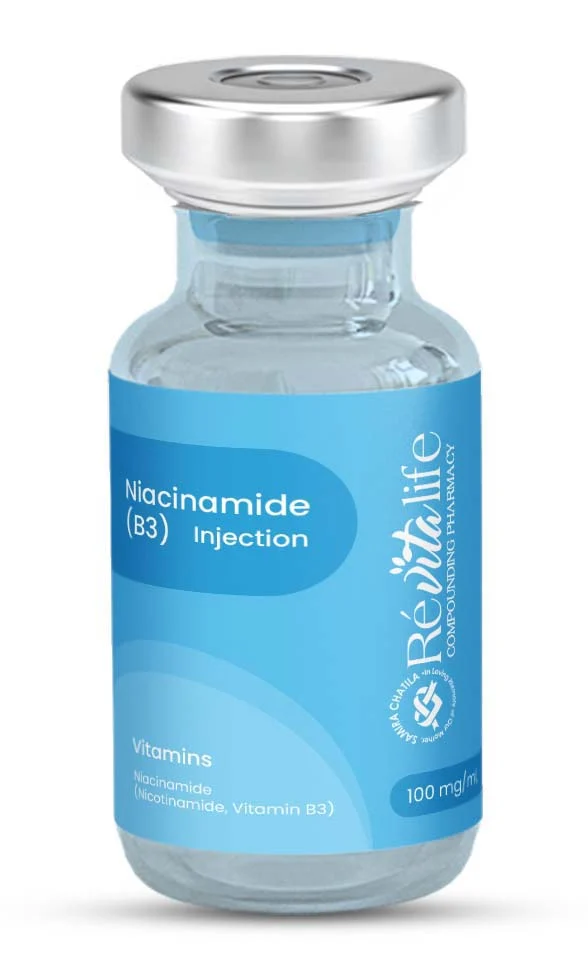
Niacinamide Injection

Niacinamide (Nicotinamide, Vitamin B3)100 mg/mL

Generic Name: Niacinamide (Nicotinamide) Class: Water-soluble vitamin; Vitamin B3 amide derivative Pharmacologic Category: Nutritional supplement; coenzyme precursor Available Forms (clinical use): Injectable niacinamide (varies by manufacturer; usually 100 mg/mL or similar concentration) Also available in oral tablet/capsules, but this monograph addresses IV use Clinical Indications for Injectable Niacinamide (evidence-based): Treatment or prevention…

Prescription-led preparation
Availability and formulation are confirmed by the pharmacy after professional review.

ABOUT THIS PREPARATION

A considered approach to personalized care

01Personalized preparationPrepared around the prescription and patient need.
02Pharmacy-led careProfessional guidance from the RevitaLife team.
03Made with care in DubaiA considered compounding experience from enquiry onward.

Product overview

Everything you need to know

Explore the preparation, dosage, clinical information, precautions, storage guidance and references held in this product record.

01About Niacinamide Injection

Generic Name: Niacinamide (Nicotinamide)
Class: Water-soluble vitamin; Vitamin B3 amide derivative
Pharmacologic Category: Nutritional supplement; coenzyme precursor
Available Forms (clinical use):

  • Injectable niacinamide (varies by manufacturer; usually 100 mg/mL or similar concentration)
  • Also available in oral tablet/capsules, but this monograph addresses IV use

Clinical Indications for Injectable Niacinamide (evidence-based):

  • Treatment or prevention of niacin deficiency (pellagra) when oral administration is not possible
  • Part of specially formulated parenteral nutrition solutions
  • Severe malabsorption states requiring parenteral vitamin support

Off-label uses sometimes seen in wellness clinics:

  • Part of “IV vitamin drips,” antioxidant infusions, “skin brightening” protocols
    Important: These uses lack robust clinical trial data and should be performed only with full informed consent and medical oversight.
02Dosage

Important Safety Note: Specific IV dosing should only be determined by a licensed prescriber. Below are standard medical references, not individualized medical advice.

Evidence-Based Therapeutic Doses (for deficiency / hospital use)

  • Adults: Typically 100–500 mg/day IV, depending on severity of deficiency and clinical status
  • Pellagra (severe deficiency): Sometimes up to 1,000 mg/day divided IV/IM/PO, then tapered
  • Parenteral nutrition: Incorporated into multivitamin formulations (usually 40 mg/day)

Infusion Considerations

  • Given slow IV infusion to reduce adverse reactions
  • Should not be mixed with incompatible solutions (see interactions)
  • Must use sterile, preservative-free medical-grade products intended for injection

NOT recommended:

  • Very high-dose IV niacinamide for “anti-aging,” “detox,” or “energy drips,” due to lack of evidence and risk of hepatic toxicity.
03Mechanisms of Action

Niacinamide is a biologically active form of Vitamin B3 that acts as a precursor of:

1. NAD⁺ (Nicotinamide adenine dinucleotide)

  • Essential for cellular energy metabolism (glycolysis, Krebs cycle, oxidative phosphorylation)
  • Required for ATP production in mitochondria

2. NADP⁺ (Nicotinamide adenine dinucleotide phosphate)

  • Important for fatty acid synthesis, cholesterol metabolism, and detoxification reactions
  • Plays a major role in antioxidant pathways (glutathione regeneration)

3. DNA Repair & Cell Survival

Niacinamide supports enzymes such as:

  • Poly(ADP-ribose) polymerases (PARPs) — involved in DNA repair
  • Sirtuins — regulate aging, metabolism, and inflammation

4. Anti-inflammatory Actions

  • Reduces production of inflammatory cytokines
  • Modulates neutrophil chemotaxis
  • Stabilizes epidermal barrier function

5. Skin Effects

  • Reduces melanosome transfer (may help hyperpigmentation)
  • Improves epidermal barrier by increasing ceramide synthesis
  • Antioxidant properties reduce oxidative stress
04Contraindications & Precautions

Absolute Contraindications

  • Known hypersensitivity to niacinamide or formulation components
  • Severe hepatic impairment (risk of hepatotoxicity)

Relative Contraindications / Use With Caution

  • Renal impairment (accumulation possible at very high doses)
  • Active peptic ulcer disease
  • Uncontrolled gout or hyperuricemia
  • Diabetes mellitus
    • Niacinamide may affect glucose tolerance
  • Hypotension
    • Vasodilatory effects may exacerbate low blood pressure
  • History of severe flushing reaction to niacin
    • Niacinamide produces minimal flushing but caution is still advised

IV-specific Precautions

  • Must be given slowly to prevent local irritation or systemic reactions
  • Monitor LFTs in prolonged or high-dose therapy
  • Use caution in patients with multiple vitamin infusions to avoid cumulative toxicity
05Drug & Nutrient Interactions

Potential Interactions

  • Carbamazepine, valproic acid
    • Additive hepatic stress
  • Isoniazid
    • Alters vitamin metabolism; may require adjustment
  • Anticoagulants (warfarin)
    • Rare reports of altered INR; monitor closely
  • Hypoglycemic agents
    • Niacinamide may impair glucose tolerance

Nutrient Interactions

  • Works synergistically with riboflavin (B2), which helps NAD/NADP recycling
  • High doses may alter metabolism of other B-complex vitamins
  • In parenteral nutrition, must be included in balanced multivitamin mixture to prevent imbalance

Compatibility (IV)

  • Compatible in many parenteral nutrition solutions
  • Avoid mixing with:
    • Strong oxidizing agents
    • Highly alkaline solutions
    • Calcium-rich mixtures unless verified safe
06Adverse Reactions / Side Effects

Common (usually dose-dependent)

  • Nausea, vomiting
  • Headache
  • Mild flushing or warmth
  • Injection-site irritation
  • Dizziness or lightheadedness
  • Mild hypotension

Moderate

  • Hepatotoxicity (elevated ALT/AST)
  • Hyperuricemia / gout flare
  • Insulin resistance or hyperglycemia
  • GI upset

Severe / Rare

  • Acute liver failure (extremely high doses)
  • Thrombocytopenia
  • Anaphylactoid reactions (very rare)
  • Severe hypotension during rapid IV infusion

Monitoring Requirements for IV Use

  • Liver function tests (especially with repeated or high-dose use)
  • Renal function
  • Blood glucose in diabetic patients

Blood pressure during infusion

07Pregnancy & Breastfeeding

Pregnancy

  • Niacinamide is generally considered safe in pregnancy when used in standard nutritional doses.
  • High-dose IV therapy has not been extensively studied, and should only be administered if medically necessary.
  • Animal studies do not show teratogenicity at standard doses.

Breastfeeding

  • Niacinamide is excreted into breast milk in small amounts.
  • Standard doses are considered compatible with breastfeeding.
  • High or therapeutic IV doses should be used with caution and require risk-benefit evaluation.
08Storage
  • Store vials at controlled room temperature: 20–25°C (68–77°F)
  • Protect from light to prevent degradation
  • Do not freeze
  • Use only clear solutions—discard if cloudy, tinted, or particulate matter present
  • Use single-dose vials promptly after opening (if not preservative-free)
  • Follow manufacturer-specific storage recommendations
09References

(Professional medical & pharmacologic sources)

  1. NIH Office of Dietary Supplements. Niacin Fact Sheet – National Institutes of Health
  2. Lexicomp Online / UpToDate – Niacinamide drug monograph
  3. Micromedex (IBM Watson) – Niacinamide injectable formulation data
  4. American Society for Parenteral and Enteral Nutrition (ASPEN) – Parenteral vitamin guidelines
  5. Carpenter KJ. Niacin. Academic Press.
  6. World Health Organization (WHO). Parenteral Nutrition Guidelines.
  7. Chan AY. Adverse effects of high-dose niacin therapy. Clin Pharmacol Ther.


Related topics
compounding pharmacyinjectionIV Therapyniacinamide injectionprescription supportvitamin and nutrient support

Professional guidance

Start with the prescription, not the product.

Compounded preparations are supplied only when clinically appropriate and supported by a valid prescription. Product information is educational and does not replace advice from a licensed healthcare professional.

Upload prescription
EXPLORE MORE

Related preparations

Other RevitaLife preparations from the same category.