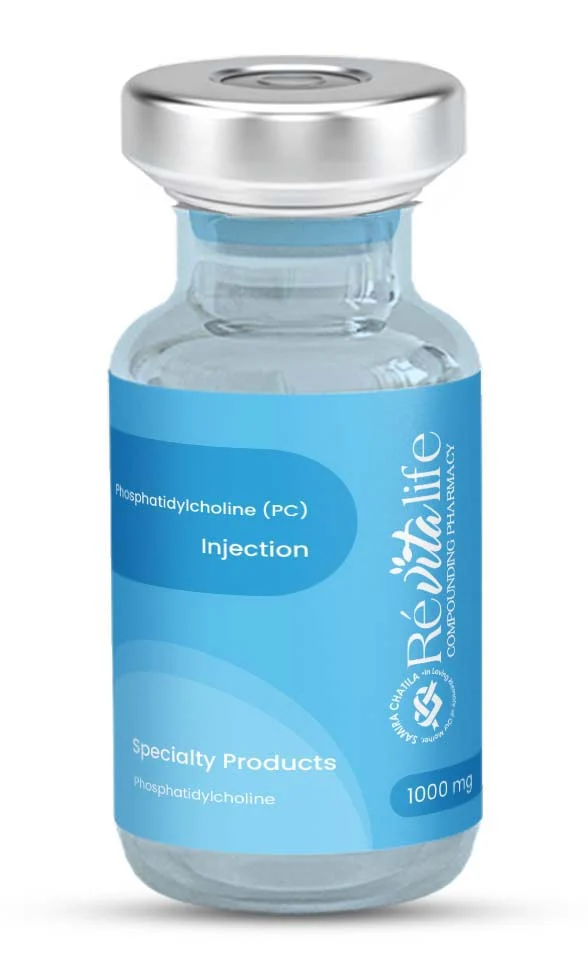
Phosphatidylcholine (PC) is a phospholipid that serves as a major component of cell membranes and lipoproteins (especially HDL and LDL). It is commonly derived from soy lecithin and used both therapeutically and cosmetically. In clinical and compounding practice, phosphatidylcholine is often combined with deoxycholic acid (DCA) in mesotherapy and IV formulations to:…
Prescription-led preparation
Availability and formulation are confirmed by the pharmacy after professional review.
Product overview
Explore the preparation, dosage, clinical information, precautions, storage guidance and references held in this product record.
Phosphatidylcholine (PC) is a phospholipid that serves as a major component of cell membranes and lipoproteins (especially HDL and LDL). It is commonly derived from soy lecithin and used both therapeutically and cosmetically. In clinical and compounding practice, phosphatidylcholine is often combined with deoxycholic acid (DCA) in mesotherapy and IV formulations to: Support liver detoxification Improve fat metabolism Enhance cellular membrane repair Support neurological function
Lipid metabolism:
Enhances breakdown and mobilization of fat by emulsifying lipids.
Cell membrane repair:
Restores phospholipid bilayer integrity in hepatic and neuronal cells. Liver protection: Promotes regeneration of hepatocytes and supports bile flow.
Circulatory improvement:
Enhances blood viscosity and cholesterol transport. Adipocytic action (subcutaneous use): When combined with deoxycholate, disrupts adipocyte membranes leading to localized fat reduction.
Intravenous (IV) Use Purpose: Liver detox, lipid metabolism, cell repair, anti-aging, and general wellness.
| Parameter | Description |
| Concentration | 50mg/mL in 20 mL (total 1000 mg) |
| Dilution | Dilute in 250 or 500 mL of normal saline |
| Frequency | 1–2 times per week for 4–8 weeks |
| Administration Time | Infuse over 30–60 minutes |
Notes: Avoid mixing PC directly with strong oxidizing agents (e.g., vitamin C). Must be administered slowly to avoid vein irritation.
Subcutaneous (SQ) Use Purpose: Localized fat reduction (lipolysis/mesotherapy)
| Parameter | Description |
| Concentration | 50–250 mg |
| Dose per Site | 0.2–0.5 mL per injection site |
| Total Volume per Session | Up to 5–10 mL depending on area |
| Frequency | Every 7–14 days, for 4–8 sessions |
Notes: Massage area post-injection to enhance dispersion. Common treatment areas: abdomen, thighs, flanks, upper arms, submental fat.
Pregnancy, breastfeeding, active infection at injection site, soy allergy, severe hepatic or renal impairment. Common Reactions: Local pain, swelling, redness, transient burning (for SQ), mild nausea (for IV).
Intravenous / Systemic PC / Phospholipid Therapy Studies 1. “Effect of intravenous polyunsaturated phosphatidylcholine infusion” This study infused polyunsaturated PC and observed a lower erythrocyte cholesterol:phospholipid ratio and increased polyunsaturated fatty acids (mainly linoleic acid). Also noted improvement in the regulation (downregulation) of insulin receptor behavior correlating with membrane lipid changes. PubMed 2. “Acute Effects of Intravenous Infusion of apoA1 / Phosphatidylcholine Discs” In 7 healthy men, infusion of apoA1/PC discs over 4 hours increased plasma apoA1 and phospholipids, then led to changes in HDL particle distribution and cholesterol esterification dynamics. AHA Journals 3. “Effectiveness of phosphatidylcholine as adjunctive therapy in NAFLD” This in-depth observational / real-world trial (2,843 patients) examined the use of polyenylphosphatidylcholine (PPC) as adjunct therapy in nonalcoholic fatty liver disease (NAFLD). Over 24 weeks, ALT, AST, and GGT levels decreased significantly. PMC Also, a related study showed improvement in ultrasonographic hepatic steatosis in ~81% of patients using PPC adjunct therapy. PMC 4. Plaquex / Intravenous Phosphatidylcholine Clinical Program Some sources mention “126 clinical studies with 8,334 patients including a Phase IV multicenter study (2,862 patients)” using intravenous PC (“Plaquex” brand) for lipid peroxidation prevention and atherosclerosis. Regen Med KY However, I was unable to locate full peer-reviewed publications of all these trials in mainstream medical journals. 5. Phase 1 study of AYP-101 (soybean phosphatidylcholine) A recent first-in-human trial of a new SPC (soy phosphatidylcholine) formulation solubilized in glycocholic acid (GCA) showed good formulation stability and no major safety signals. There is no published efficacy yet for fat-reducing effect in humans. BioMed Central Subcutaneous / Injection Lipolysis / Mesotherapy Use of PC 1. “Injection Lipolysis: A Systematic Review of Literature and Our Clinical Experience” This review concludes that PC + deoxycholic acid (PC–DC) cocktails (local injections) show effectiveness in reducing unwanted fat deposits, especially in face, upper arm, and submental areas. PMC The authors emphasize the need for proper patient selection and technique. PMC 2. “Mesotherapy and Phosphatidylcholine Injections” (PubMed / LWW) Reviews the historical and conceptual distinctions between mesotherapy and PC injections. Notes that although experimental data suggest fat-reducing effects, clinical evidence is weak and many reports are anecdotal. Lippincott Journals+1 Suggests that the detergent (membrane-disrupting) action of deoxycholate may be more important than PC itself. Lippincott Journals 3. “Clinical experience and safety using phosphatidylcholine injections” This retrospective report assesses outcomes and adverse effects associated with subcutaneous PC injections over many years. Wiley Online Library It notes that PC has been used “for over 30 years” and reports generally mild adverse effects (pain, swelling) but raises safety concerns. Wiley Online Library 4. “Submental fat reduction by mesotherapy using phosphatidylcholine” Twelve patients with submental fat deposits received 1–5 treatment sessions with either PC alone or PC + organic silicium.
Professional guidance
Compounded preparations are supplied only when clinically appropriate and supported by a valid prescription. Product information is educational and does not replace advice from a licensed healthcare professional.
Upload prescription →