Compounded topical numbing Cream prepared under section 503A integrate high-concentration local anesthetics to deliver rapid, profound, and localized analgesia before dermatologic, cosmetic, or minor surgical procedures. The multi-agent approach balances rapid onset (benzocaine), intermediate depth (lidocaine), and prolonged duration (tetracaine), while phenylephrine’s vasoconstriction minimizes bleeding and systemic anesthetic uptake during procedures such…
Prescription-led preparation
Availability and formulation are confirmed by the pharmacy after professional review.
Product overview
Explore the preparation, dosage, clinical information, precautions, storage guidance and references held in this product record.
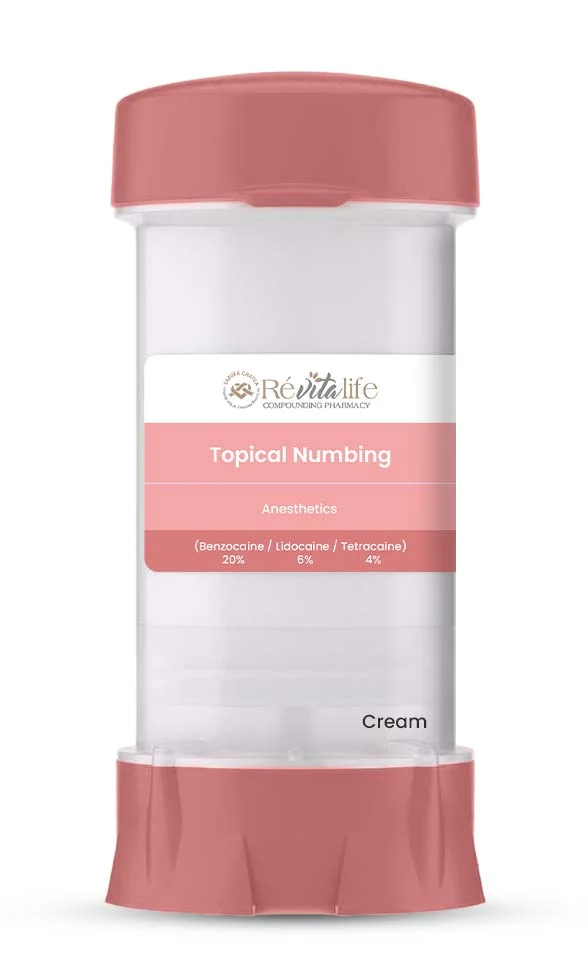
Compounded topical numbing Cream prepared under section 503A integrate high-concentration local anesthetics to deliver rapid, profound, and localized analgesia before dermatologic, cosmetic, or minor surgical procedures.
The multi-agent approach balances rapid onset (benzocaine), intermediate depth (lidocaine), and prolonged duration (tetracaine), while phenylephrine’s vasoconstriction minimizes bleeding and systemic anesthetic uptake during procedures such as laser resurfacing, tattoo removal, and filler injections.
Despite clinical utility, misuse-particularly excessive area coverage, occlusion, or heat application-can lead to systemic toxicity, highlighting the necessity of medical supervision, precise dosing, and strict adherence to application instructions.
General adult directions involve a thin layer (≈ 2 g per 10 cm²) applied to intact skin for 15-60 minutes, depending on formulation and procedural needs, followed by thorough removal.
Maximum surface area and dose are prescriber-determined; repeat dosing within 24 hours is discouraged unless explicitly authorized.
Gloves should be worn during application, and occlusive dressings or external heat must be avoided unless specifically prescribed. [7]
Local anesthetics exert their effect by reversibly blocking voltage-gated sodium channels within peripheral sensory nerves, thereby preventing action-potential propagation.
The differing physicochemical profiles of ester anesthetics (benzocaine, tetracaine) and amide anesthetics (lidocaine, prilocaine) are exploited to achieve synergistic anesthesia: benzocaine offers near-instant surface numbing, lidocaine / prilocaine provide intermediate depth, and tetracaine prolongs blockade due to strong receptor affinity.
Phenylephrine, an α₁-adrenergic agonist present in one formulation, constricts superficial vessels, decreasing perfusion, limiting drug washout, and extending local anesthetic residence time while reducing procedural bleeding.
Although systemic absorption is minimal on intact skin when recommended amounts are used, excessive application or compromised epidermal integrity can permit dangerous plasma concentrations, emphasizing careful surface area restriction and exposure duration. [2]
These ointments are contraindicated in individuals with hypersensitivity to ester or amide anesthetics, para-aminobenzoic acid derivatives, or formulation excipients.
Contraindications also include congenital or idiopathic methemoglobinemia, glucose-6-phosphate dehydrogenase deficiency, severe cardiac conduction disorders, and application over abraded, inflamed, or infected skin, all of which elevate systemic absorption risk and potential toxicity. [3]
Concurrent use of oxidizing agents such as benzoyl peroxide can chemically degrade benzocaine, diminishing anesthetic efficacy.
Layering multiple anesthetic products-topical or injectable-produces additive systemic exposure and heightened toxicity risk.
Systemic medications known to induce methemoglobinemia (e.g., sulfonamides, nitrates, dapsone) may potentiate methemoglobin formation when combined with benzocaine- or prilocaine-containing formulations, necessitating vigilant monitoring or alternative analgesic selection. [4]
Common localized effects include transient stinging, erythema, blanching, or mild edema.
Over-application, prolonged contact, or use on compromised skin can precipitate systemic toxicity, manifesting as circumoral numbness, dizziness, tinnitus, seizures, arrhythmias, or profound CNS depression.
Rare but serious methemoglobinemia, primarily associated with benzocaine or prilocaine, presents with cyanosis and hypoxia and requires immediate methylene-blue therapy.
Regulatory alerts document severe outcomes-including fatalities-when concentrated anesthetic creams were misapplied under occlusion, underscoring stringent adherence to dosing limits.
Evidence regarding high-strength topical anesthetic combinations in pregnancy is limited; professional obstetric guidelines recommend avoiding elective exposure during the first trimester and using the minimal effective dose thereafter.
Breastfeeding individuals should restrict use to medically necessary scenarios, ensuring no cream contacts breast tissue to prevent infant ingestion.
Keep Compounded Topical Numbing Ointment tightly sealed in its original container at controlled room temperature, 20 - 25 °C (68 - 77 °F), protected from excessive heat, moisture, and direct light.
Because the tablets disintegrate upon moisture contact, bathrooms and kitchens are unsuitable storage sites.
- Link Opens in New Tab](https://www.ncbi.nlm.nih.gov/books/NBK499964/)
- Link Opens in New Tab](https://doi.org/10.1080/09546634.2020.1856789)
- Link Opens in New Tab](https://www.fda.gov/media/72154/download)
- Link Opens in New Tab](https://dermnetnz.org/topics/topical-anaesthetics)
- Link Opens in New Tab](https://www.fda.gov/consumers/consumer-updates)
Professional guidance
Compounded preparations are supplied only when clinically appropriate and supported by a valid prescription. Product information is educational and does not replace advice from a licensed healthcare professional.
Upload prescription →Questions and answers
It may provide targeted, temporary anesthesia so that minor procedures can be completed with minimal discomfort.
Anesthesia typically develops within 20-30 minutes and may endure for 1-3 hours after removal.
Clinical trials show high-strength lidocaine-prilocaine combinations can obviate needle infiltration for superficial procedures under specific conditions.
Prolonged contact elevates systemic absorption risk, potentially leading to seizures, arrhythmias, or other severe toxicities.
Repeated exposure, especially to ester agents like benzocaine, can cause contact dermatitis or urticaria.
Yes; thinner skin and reduced hepatic clearance in older patients may warrant smaller treatment areas and shorter exposure times.
Resuscitation guidelines include airway support, benzodiazepines for seizures, and lipid emulsion therapy for refractory manifestations.
Phenylephrine constricts cutaneous vessels, potentially limiting bleeding and prolonging anesthetic residence.
Palpitations, confusion, tinnitus, bluish lips, or sudden light-headedness warrant urgent evaluation.
Return unused medication to a take-back program or seal it with an unpalatable substance before household disposal.