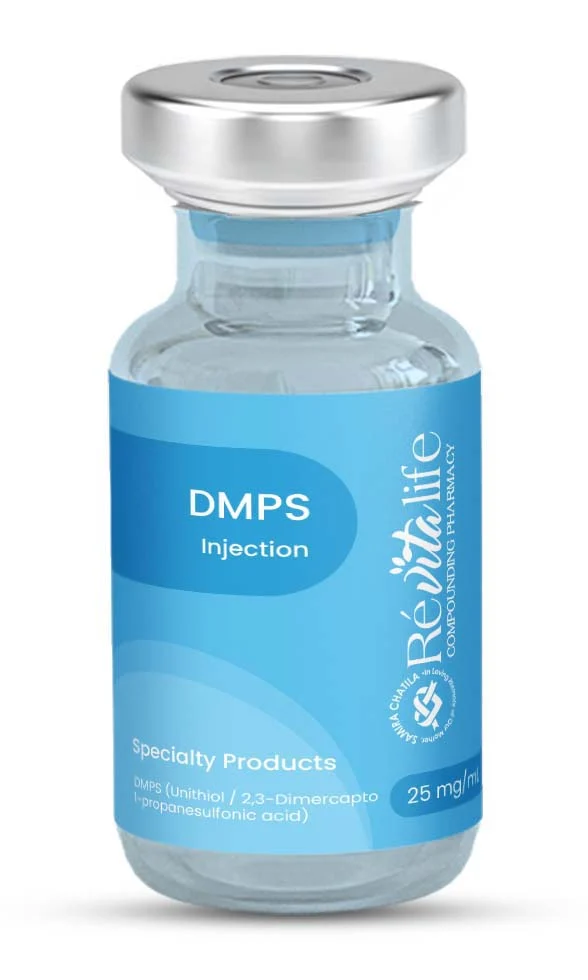
Generic Name: Dimercapto-1-propanesulfonic acid Common Name: DMPS Brand Names: Dimaval®, Unithiol (varies by country) Drug Class: Chelating agent; antidote for heavy metal poisoning Approved Routes in Some Countries: IV (intravenous) IM (intramuscular) Oral (less effective) FDA status (U.S.): Investigational; may be used under physician guidance, especially in toxicology settings. Primary Clinical Indications…
Prescription-led preparation
Availability and formulation are confirmed by the pharmacy after professional review.
Product overview
Explore the preparation, dosage, clinical information, precautions, storage guidance and references held in this product record.
Generic Name: Dimercapto-1-propanesulfonic acid
Common Name: DMPS
Brand Names: Dimaval®, Unithiol (varies by country)
Drug Class: Chelating agent; antidote for heavy metal poisoning
Approved Routes in Some Countries:
Primary Clinical Indications (Medically Recognized):
Non-approved uses:
DMPS dosing is highly individualized, based on:
Note: The following reflects literature-cited clinically used ranges, not instructions. Actual administration must follow specialist toxicology protocols.
A. Acute Mercury or Arsenic Poisoning (IV use)
Published toxicology references describe:
B. Lead Poisoning
Important Clinical Caveats
A. Strong Dithiol Chelating Agent
DMPS contains two thiol (-SH) groups capable of binding divalent and trivalent metal ions, forming stable, water-soluble complexes.
B. Enhanced Renal Excretion
The metal-DMPS complexes are primarily excreted through the kidneys, increasing elimination of:
C. Higher Water Solubility Compared to DMSA
This makes DMPS suitable for IV use, with faster onset in emergency toxicology.
D. Does Not Cross the Blood–Brain Barrier Well
Thus, DMPS primarily chelates metals in plasma and soft tissues—not CNS stores.
E. Lower Risk of Metal Redistribution
Compared to some chelators, DMPS tends to cause less shifting of metals into more sensitive tissues, though this risk is not eliminated.
Absolute Contraindications
Relative Contraindications
Toxicology-Specific Precautions
IV-Specific Precautions
A. Mineral/Electrolyte Interactions
DMPS may non-selectively chelate essential minerals in trace amounts:
Prolonged or high-dose therapy can cause micronutrient depletion.
B. Concomitant Chelation Agents
When combined with other chelators (EDTA, DMSA):
C. Drugs Eliminated Renally
DMPS chelation can alter renal clearance:
D. Antioxidants
High-dose antioxidants may alter redox status and theoretically interact with chelation, though data is limited.
Common (usually mild and self-limited):
Moderate:
Serious (require immediate discontinuation):
A. Anaphylactoid Reactions
Higher risk in patients with multiple allergies or asthma.
B. Stevens-Johnson Syndrome / Toxic Epidermal Necrolysis
Rare but reported.
C. Renal Injury
Because chelated metals are excreted renally, there is risk of:
D. Electrolyte Disturbances
E. Metal Redistribution
If not administered properly, may mobilize metals from tissues into circulation.
Pregnancy
Breastfeeding
(General standard medical references; no web browsing used.)
Professional guidance
Compounded preparations are supplied only when clinically appropriate and supported by a valid prescription. Product information is educational and does not replace advice from a licensed healthcare professional.
Upload prescription →